
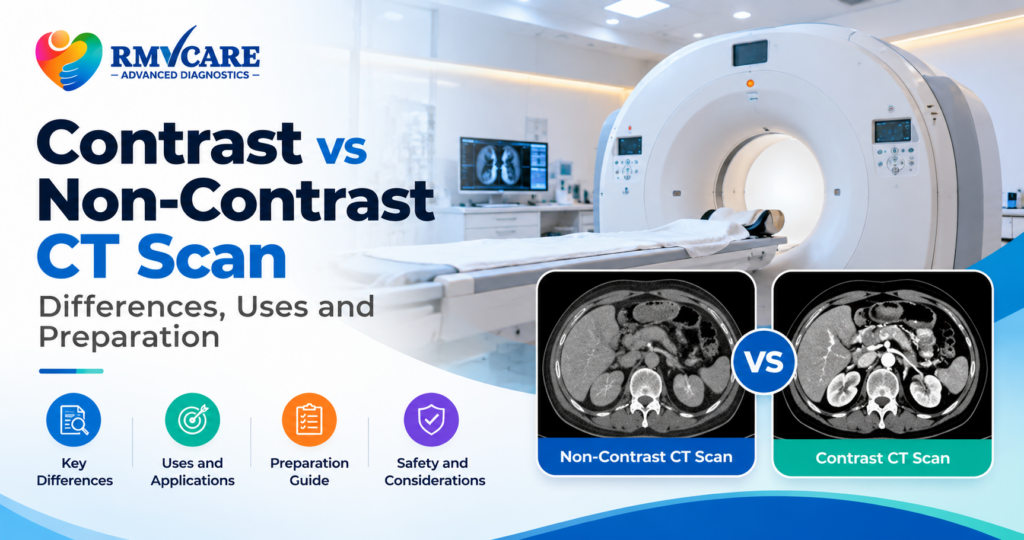
Contrast vs Non-Contrast CT Scan: Differences, Uses and Preparation
A CT scan, also known as computed tomography, is an imaging test that uses X-rays and computer processing to create detailed images of structures inside the body. Depending on the medical question, a doctor may recommend a contrast CT scan or a non-contrast CT scan.
Understanding the difference between a contrast vs non contrast CT scan can help you prepare for your appointment and know what to expect. Both techniques are valuable in medical imaging, but they serve different purposes depending on the body part being examined and the condition being investigated.
At RM VCare Advanced Diagnostic Center in Kandivali, Mumbai, patients can seek information about diagnostic imaging and the preparation required for their prescribed examination. The appropriate CT scan protocol should always be determined by the treating doctor and radiology team.
What Is a Contrast CT Scan?
A contrast CT scan uses a contrast agent, commonly an iodine-based contrast material, to make certain organs, blood vessels and tissues easier to distinguish on CT images.
For many examinations, the contrast material is administered through a vein in the arm. Depending on the type of examination, contrast may instead be swallowed or administered by another route.
Contrast material changes how certain structures appear on the images, helping radiologists assess differences between tissues and evaluate blood vessels or particular abnormalities.
When Is a Contrast CT Scan Used?
A doctor may recommend a contrast-enhanced CT scan for purposes such as:
- Abdominal and pelvic evaluation: To assess certain organs, inflammatory changes, masses and other abnormalities.
- Cancer assessment: To help evaluate some tumours, their extent and their relationship with nearby structures.
- Blood vessel imaging: To examine blood vessels when a CT angiography or another suitable vascular protocol is indicated.
- Infection and inflammation: To investigate selected conditions involving organs or soft tissues.
- Chest imaging: To evaluate particular abnormalities when contrast improves the information needed.
The need for contrast depends on the clinical question. Not every abdominal, chest or pelvic CT scan requires contrast.
What Is a Non-Contrast CT Scan?
A non-contrast CT scan is performed without administering a contrast agent. The scanner still produces detailed cross-sectional images using X-rays and computer processing.
For certain conditions, images without contrast provide the information a doctor needs. In some situations, avoiding contrast is preferable because it is unnecessary for the examination or because the clinical team needs to consider the patient’s individual circumstances.
When Is a Non-Contrast CT Scan Used?
Non-contrast CT may be recommended for specific examinations, including:
- Suspected kidney stones: A non-contrast CT of the kidneys, ureters and bladder, commonly called CT KUB, is frequently used to investigate urinary stones.
- Head injury: A non-contrast CT of the head may be used in selected emergency situations to assess for acute bleeding or injury.
- Certain lung examinations: Some protocols, including many high-resolution CT examinations of the lungs, are performed without contrast.
- Bone assessment: Non-contrast CT can provide detailed images of selected bones and complex fractures.
- Specific follow-up examinations: Some conditions can be assessed using a non-contrast protocol when clinically appropriate.
The best imaging method depends on the suspected condition, the body part being examined and the doctor’s assessment.
Contrast vs Non-Contrast CT Scan: Key Differences
The main difference is whether a contrast agent is used to improve the visibility of particular structures.
| Feature | Contrast CT scan | Non-contrast CT scan |
|---|---|---|
| Contrast agent | Used when indicated | Not administered |
| Main purpose | Helps distinguish selected tissues, organs and blood vessels | Provides detailed images without contrast enhancement |
| Common applications | Selected abdominal, pelvic, vascular and tumour assessments | Kidney stones, selected head scans, bone assessment and other protocols |
| Preparation | Depends on the examination and contrast route | Depends on the body part and examination |
| Additional considerations | Allergies, kidney function and other relevant clinical factors may need assessment | Avoids risks specifically associated with administered contrast, but still involves CT radiation |
| Best choice | When contrast provides the information needed | When non-contrast images are appropriate for the clinical question |
Neither technique is universally better. A contrast CT scan is not automatically more accurate for every condition, and a non-contrast scan is not automatically safer or sufficient for every patient.
How Does Contrast Material Improve CT Images?
Contrast material helps make differences between selected tissues more visible. When iodine-based contrast is injected into a vein, it travels through the bloodstream and changes the appearance of blood vessels and tissues that receive the blood supply.
Radiologists can use these changes to evaluate certain abnormalities, including their enhancement patterns and relationship with surrounding structures.
The timing of the images after contrast administration can also matter. Some examinations use specific imaging phases to answer different clinical questions.
For example, a CT examination designed to assess blood vessels may require a different protocol from a routine abdominal CT. This is why the scan should be planned according to the doctor’s request rather than choosing contrast or non-contrast imaging independently.
How to Prepare for a Contrast CT Scan
Preparation depends on the type of CT scan, whether contrast is required, the route of administration and your medical history.
Before your appointment, follow the instructions provided by the diagnostic centre and your treating doctor.
1. Inform the Team About Your Medical History
Tell the medical team if you have:
- Previously experienced a reaction to iodinated CT contrast.
- Kidney disease or reduced kidney function.
- Diabetes and take medicines that may require special instructions.
- A possibility of pregnancy.
- Other significant medical conditions or relevant medication use.
These details help the clinical team determine whether additional precautions or testing are needed.
2. Ask Whether Fasting Is Required
Fasting is not necessary for every CT scan. Some examinations or local protocols may require you to avoid food or drink for a specified period.
Confirm your preparation instructions in advance rather than assuming that all contrast CT scans require fasting.
3. Bring Relevant Medical Records
Carry your prescription, previous scan reports and relevant blood test results if requested. Kidney function testing may be required for certain patients before receiving intravenous contrast.
4. Follow Medication Instructions Carefully
Do not stop prescribed medicines on your own. If you take metformin or other medicines that may be relevant to your procedure, ask your doctor or the radiology team whether any specific instructions apply.
5. Arrive Prepared for the Examination
You may be asked to remove metal objects or change into suitable clothing. If intravenous contrast is planned, a healthcare professional may place a small cannula in a vein in your arm.
Are There Any Risks Associated With Contrast CT Scans?
CT examinations use ionising radiation, so the benefits and potential risks should be considered for every patient. The imaging team should use an appropriate protocol and radiation dose for the clinical question.
Intravenous iodinated contrast is generally well tolerated, but it can have additional risks.
Contrast Reactions
Some people experience mild reactions, such as nausea, warmth or itching. Allergic-like reactions can also occur, and severe reactions are uncommon but possible.
Always tell the team if you have had a previous reaction to CT contrast. A history of such a reaction may affect how the examination is planned.
Kidney Function Considerations
In some patients, particularly those with acute kidney injury or severe kidney impairment, iodinated contrast requires additional consideration. The medical team may review kidney function and weigh the potential benefits against the risks.
Having kidney disease does not automatically mean that contrast can never be used. The decision depends on the patient’s circumstances and the clinical need.
Pregnancy Considerations
Inform your doctor if you are pregnant or might be pregnant before undergoing CT imaging. The team will assess whether the examination is necessary and whether another suitable imaging method is available.
Is a Non-Contrast CT Scan Safer Than a Contrast CT Scan?
A non-contrast CT scan avoids the additional risks associated with administering a contrast agent. However, it still involves ionising radiation.
A contrast CT scan may be the more appropriate examination when the additional information it provides is important for diagnosis or treatment planning.
The safest and most suitable option is the examination that answers the clinical question while appropriately considering the patient’s individual risks. Do not request a non-contrast scan solely to avoid contrast without discussing it with your doctor.
How Long Does a CT Scan Take?
The actual scanning time is often relatively short, but the complete appointment may take longer because of registration, preparation, positioning and any required contrast administration.
A non-contrast examination may be completed without the additional steps needed for intravenous contrast. A contrast examination can require time for cannula placement, administration and imaging at the appropriate time.
The duration varies according to the body part being examined and the specific CT protocol. Ask the diagnostic centre for an estimate when scheduling your appointment.
Which CT Scan Should You Choose?
You should not select a contrast or non-contrast CT scan based only on price, convenience or an online comparison.
The decision depends on several factors:
- The symptoms or condition being investigated.
- The body part being examined.
- The information the doctor needs from the images.
- Your medical history and any relevant risk factors.
- The imaging protocol recommended by the radiologist or treating doctor.
For example, suspected urinary stones are often investigated with non-contrast CT KUB, whereas certain abdominal abnormalities or blood vessel conditions may require contrast-enhanced imaging.
Your doctor can explain why a particular protocol is appropriate for your situation.
CT Scan Services at RM VCare Advanced Diagnostic Center, Kandivali
If your doctor has recommended a CT scan, understanding the examination and its preparation can make the process easier.
RM VCare Advanced Diagnostic Center serves patients in Kandivali, Mumbai. Before booking, confirm that the required CT examination is available, clarify whether contrast is planned and ask about any preparation instructions.
Bring your prescription and previous imaging reports when requested. The radiology team can guide you regarding the centre’s process and the preparation relevant to your prescribed examination.
For appointment enquiries, visit the RM VCare website and use the available contact details to confirm service availability and booking requirements.
Frequently Asked Questions
1. What is the main difference between a contrast and a non-contrast CT scan?
A contrast CT scan uses a contrast agent to make selected tissues, organs or blood vessels more visible. A non-contrast CT scan is performed without administering contrast. The choice depends on the clinical question.
2. Is contrast required for every CT scan?
No. Many CT examinations are performed without contrast, while others benefit from contrast enhancement. The required protocol depends on the body part and the condition being investigated.
3. Is fasting necessary before a contrast CT scan?
Not always. Fasting requirements depend on the examination, the contrast route and the centre’s protocol. Confirm the instructions provided for your specific appointment.
4. Can I undergo a contrast CT scan if I have kidney problems?
Possibly, but your doctor and radiology team may need to assess your kidney function and the urgency of the examination. The decision should be individualised.
5. Does a non-contrast CT scan involve radiation?
Yes. Both contrast and non-contrast CT scans use X-rays. The contrast agent does not itself produce the radiation.
6. Is contrast CT better than non-contrast CT?
Neither is universally better. Contrast improves the visibility of certain structures, while non-contrast imaging is sufficient or preferred for other clinical questions.
7. How do I book a CT scan in Kandivali?
Visit the RM VCare Advanced Diagnostic Center website to find the available contact information. Confirm the required examination, availability, preparation instructions and appointment details before visiting.
Conclusion
Understanding the difference between a contrast vs non contrast CT scan can help you know why different imaging protocols are used and what preparation may be required.
Contrast CT scans can provide additional information about selected organs, tissues and blood vessels, while non-contrast CT scans are valuable for many examinations, including specific kidney stone and head imaging protocols.
The right choice depends on your medical needs, clinical history and doctor’s recommendation. If you have been advised to undergo CT imaging in Kandivali, contact RM VCare Advanced Diagnostic Center to confirm the available examination and preparation requirements before your appointment.
Medical information note: This article is for general educational purposes and does not replace advice from a qualified healthcare professional.